

Overview
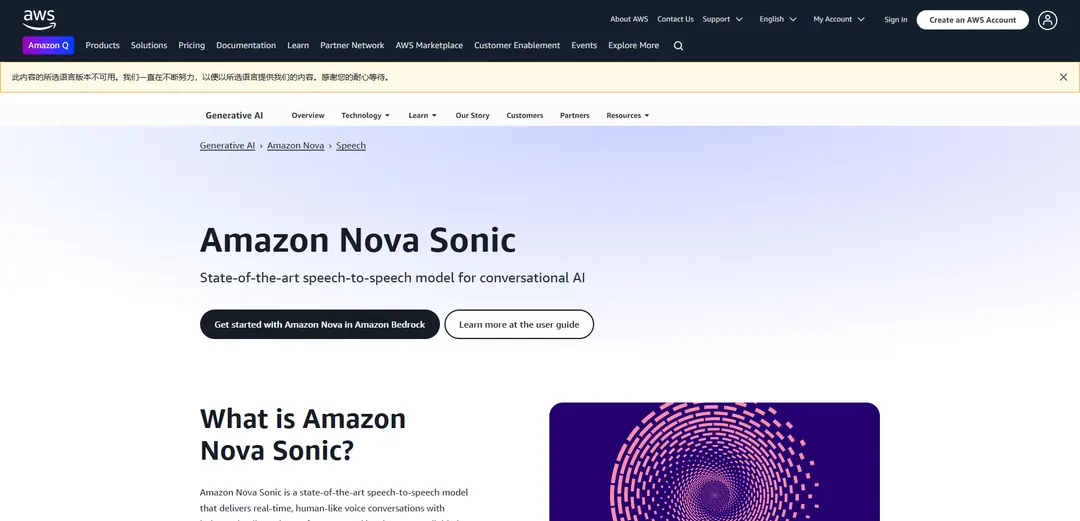
What if an AI voice assistant could understand not just your words, but the tone, pace, and emotion behind them? Amazon Nova Sonic is a foundational speech-to-speech model that unifies understanding and generation into a single system, enabling real-time, nuanced, and expressive voice conversations that feel genuinely human.
Key Features
- Unified Speech Architecture: Combines speech recognition, natural language understanding, and speech synthesis into one model, eliminating the complex orchestration typically required between separate, discrete AI systems.
- Adaptive Speech Response: Dynamically analyzes the acoustic context of input speech, including tone and prosody, to generate responses that match the user's emotional state and speaking style for a natural flow.
- Real-Time Bidirectional Streaming: Supports low-latency, two-way audio streaming, allowing for seamless, interruptible conversations without the awkward pauses common in older voice AI systems.
- Multi-Voice and Accent Support: Offers a selection of expressive voices with different characteristics, including both masculine and feminine-sounding options in American and British English accents.
- Integrated Safety and Security: Includes built-in content moderation to filter harmful content and audio watermarking to identify AI-generated audio, promoting responsible deployment.
- Enterprise Knowledge Grounding: Can be integrated with a company's internal knowledge bases and data sources to provide accurate, context-specific information during conversations.
- High-Performance Latency: Engineered for industry-leading price-performance, delivering high-quality audio synthesis with minimal computational delay, which is critical for real-time applications.
- Seamless AWS Ecosystem Integration: Native integration with Amazon Bedrock simplifies access and management, allowing developers to leverage other AWS AI services within a unified environment.
Pros
- Architectural Simplicity: The single-model approach drastically reduces the development complexity and potential points of failure compared to piecing together multiple APIs for STT, LLM, and TTS.
- Contextual Intelligence: Exceptional ability to capture and mirror speech nuances like emotion and rhythm, moving beyond simple text-based responses to create truly engaging dialogues.
- Superior Real-Time Performance: Engineered for exceptionally low latency, which is absolutely critical for maintaining a natural conversation flow without disconcerting delays.
- Scalable and Cost-Effective: As part of AWS, it benefits from massive cloud infrastructure, offering robust scalability and a compelling price-to-performance ratio for enterprises.
- Strong Safety Protections: Built-in content moderation and watermarking provide essential safeguards for public-facing deployments, mitigating brand risk and promoting ethical AI use.
- Developer-Friendly Access: Being available through the Amazon Bedrock console simplifies the process for developers to experiment, prototype, and integrate the model into applications.
Cons
- Limited Language Support: Currently primarily supports English with American and British accents, which significantly restricts its global applicability for multilingual products and services.
- AWS Platform Lock-In: The tool is deeply integrated within the Amazon Web Services ecosystem, making it less ideal for organizations committed to a multi-cloud or on-premises strategy.
- Specialized Use Case: Its core strength is real-time conversation; it may not be the optimal choice for applications that only require simple text-to-speech or batch audio processing.
- Access Control: Requires a formal access request and enabling process through Amazon Bedrock, which adds an initial step compared to instantly available pay-as-you-go APIs.
- Regional Availability: Model access is initially tied to specific AWS regions, which could complicate architecture and add latency for users and applications located outside those areas.
Use Cases
- Automated Customer Service Call Centers: Powers fully interactive voice agents that handle complex customer inquiries, provide support, and resolve issues with empathetic and context-aware responses.
- Outbound Marketing and Sales Calls: Enables AI agents to conduct proactive, conversational telemarketing or appointment reminder calls that adapt to the recipient's tone and engagement level.
- Voice-Enabled Personal Assistants: Serves as the conversational engine for next-generation digital assistants in smart home devices, cars, and mobile applications, understanding spoken commands naturally.
- Interactive Education and Language Learning: Creates immersive tutoring and language practice tools where learners can engage in realistic, unscripted dialogues and receive feedback on pronunciation.
- Accessibility Tools: Develops applications that aid individuals with disabilities by providing a more natural and responsive voice-controlled interface for technology and communication.
- Interactive Voice Response (IVR) Systems: Modernizes traditional phone menus by allowing customers to simply speak their requests naturally instead of navigating through tedious button presses.
- Content Creation and Audiobooks: Generates expressive and dynamic narration for media content, with the ability to adjust delivery based on the context of the script for a more engaging listen.
- Gaming and Metaverse NPCs: Brings non-player characters to life with real-time, voice-driven interactions, making virtual worlds more immersive and responsive to player actions and speech.
Quick Start Guide
1. Navigate to the Amazon Bedrock console in the US East (N. Virginia) AWS Region. 2. Request and enable access to the Amazon Nova Sonic model in the Model Access settings. 3. Implement the bidirectional streaming API using AWS SDKs to connect your application. 4. Configure your application to capture audio input and stream it to the model for processing.
Conclusion
Amazon Nova Sonic represents a significant architectural leap in voice AI by unifying understanding and generation. Its primary strength lies in enabling truly natural, real-time conversations with nuanced emotional intelligence. It is an exceptionally powerful solution for enterprises building sophisticated voice agents, particularly those already invested in the AWS ecosystem. However, its current limitation to English and its tight coupling with AWS are important considerations. It is highly recommended for developers focused on creating the next generation of interactive voice applications where latency and conversational quality are paramount. For projects requiring multi-language support or operating outside of AWS, alternative solutions should be evaluated.
Frequently Asked Questions
It is a proprietary foundation model by AWS that unifies speech understanding and generation into a single model, designed for enabling natural, real-time voice conversations in applications.
It currently supports multiple expressive voices in different English accents, including American and British English, with both masculine and feminine-sounding options.
Access is managed through Amazon Bedrock. Developers need to enable the model in their Bedrock console and then use AWS SDKs to integrate the bidirectional streaming API into their applications.
Common use cases include automating customer service calls, powering outbound marketing, creating voice assistants, building interactive education tools, and enhancing gaming NPC interactions.
Thanks to its low-latency bidirectional streaming capability, it can process audio in real-time, allowing for natural conversational dynamics like interruptions and rapid turn-taking.
Yes, it has built-in content moderation to filter harmful content and uses audio watermarking to help identify that the audio was generated by AI.
Yes, it supports knowledge grounding, allowing it to connect to enterprise data sources and provide responses based on specific internal information.
The unified model preserves the acoustic nuances (tone, emotion) of the input speech, which are often lost when converting to text first, leading to more expressive and context-aware responses.

