

Overview
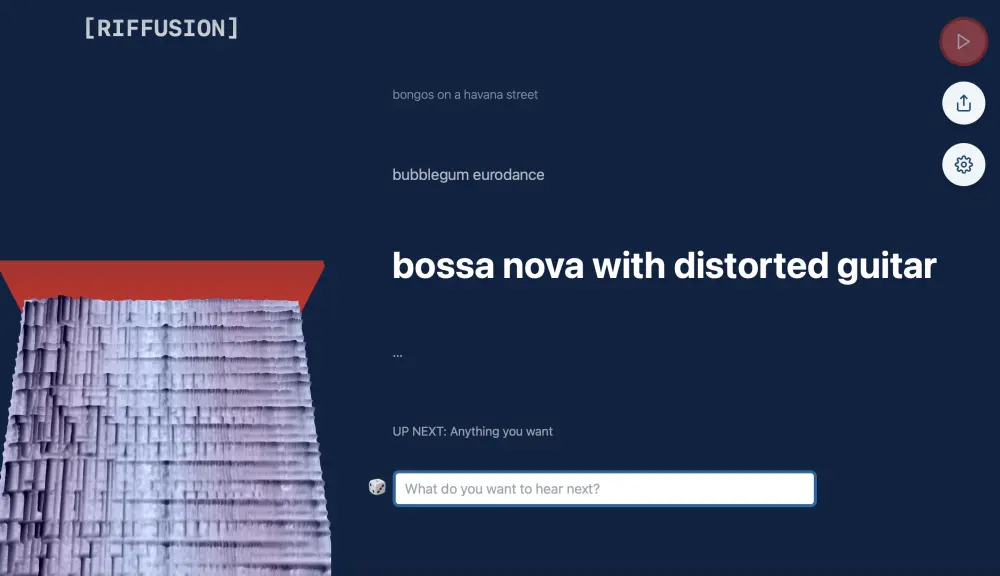
What if you could describe a song and hear it moments later? Riffusion makes this possible. This innovative AI tool, born from a hobby project, uses a fine-tuned Stable Diffusion model to generate music in real-time. It uniquely creates audio by first generating spectrogram images, translating visual patterns into sound, offering a fascinating new approach to music creation for musicians and enthusiasts alike.
Key Features
- Text-to-Music Conversion: Transforms descriptive text prompts or lyrics into complete musical compositions, allowing users to articulate a sound and hear it rendered as audio without any instrumental skill required.
- Spectrogram-Based Generation: Employs a unique method of creating visual representations of sound (spectrograms) which are then converted into audio, leveraging image generation AI for musical innovation.
- Real-Time Audio Generation: Produces music on-the-fly, enabling immediate feedback and rapid experimentation with different prompts and ideas for quick iteration and creative exploration.
- Customizable Parameters: Offers control over key musical elements including genre, instruments, tempo, and overall mood, allowing for tailored outputs that match the user's specific creative vision.
- Vibes Audio Conditioning: A feature that uses reference audio tracks to influence the style and characteristics of the generated music, providing more nuanced control over the final output's sound.
- Seed Value Adjustment: Allows users to lock and modify a specific starting point (seed) for the generation process, enabling the creation of variations on a particularly successful musical idea.
- Mobile App Accessibility: Provides a dedicated mobile application, making the powerful AI music generation tool portable and readily available for spontaneous creation anywhere.
- No Musical Expertise Required: Democratizes music production by enabling anyone, regardless of formal training or ability to play an instrument, to generate original compositions.
Pros
- Extremely Accessible Creation: Lowers the barrier to music production entirely, allowing absolute beginners to generate coherent musical ideas from simple text descriptions with no learning curve.
- Rapid Idea Prototyping: Excels at generating a high volume of musical sketches and concepts in minutes, making it an invaluable tool for brainstorming and overcoming creative block.
- Unique Technical Approach: The spectrogram-to-audio method is a genuinely novel application of image-based AI models, resulting in interesting and often unexpected sonic textures.
- Free to Use: Currently offers its core music generation capabilities without any cost, providing significant value and experimentation potential at no financial risk to the user.
- Intuitive User Interface: The process is straightforward—input text, generate audio—making the tool easy to navigate and understand for users of all technical backgrounds.
- Encourages Creative Exploration: The unpredictable nature of AI generation can lead users to discover new genres, sounds, and combinations they might not have considered otherwise.
Cons
- Variable Audio Quality: Outputs can sometimes be short, lo-fi, or contain audible artifacts and glitches, lacking the polish and clarity of professionally produced music.
- Limited Control Over Structure: Offers minimal ability to dictate song arrangement, composition length, or the precise development of musical themes over time, leading to repetitive loops.
- Potential Copyright Ambiguity: The legal status of using AI-generated music in commercial projects remains unclear and could pose a risk for creators seeking to monetize their work.
- No Advanced Audio Editing: Lacks built-in tools for fine-tuning the generated audio, such as EQ, compression, or mixing, requiring export to a Digital Audio Workstation for polishing.
- Dependence on Prompt Crafting: The quality of the output is heavily reliant on the user's ability to write effective, descriptive prompts, which can involve a trial-and-error process.
Use Cases
- Content Creator Soundtracks: Ideal for YouTubers, podcasters, and streamers to quickly generate unique, royalty-free background music and intros that perfectly match their video's theme.
- Musician Brainstorming: Serves as a digital muse for songwriters and producers to break through creative blocks by generating novel melodic ideas, rhythms, and harmonic progressions.
- Game Development Prototyping: Provides indie game developers with a fast and cost-effective method to create placeholder soundtracks and audio effects during early development phases.
- Advertising and Marketing: Enables small businesses and marketers to produce original jingles and short audio branding elements for commercials and online ads without licensing fees.
- Educational Demonstrations: A powerful tool for educators to demonstrate musical concepts, genres, and the intersection of technology and art in a tangible, engaging way for students.
- Therapeutic and Recreational Use: Offers a form of creative play and audio exploration for hobbyists and individuals using music for relaxation, meditation, or personal enjoyment.
Quick Start Guide
1. Open the Riffusion app on your mobile device or visit its website. 2. Type a descriptive text prompt into the input field (e.g., 'upbeat synthwave with a driving bassline'). 3. Click the generate button to create your audio clip. 4. Listen to the result, then use seed values or new prompts to iterate and refine your creation.
Conclusion
Riffusion is a fascinating and highly accessible entry point into AI-generated music. Its greatest strength lies in its ability to instantly materialize ideas from text, making it a superb tool for brainstorming, content creation, and pure creative experimentation. However, users should temper expectations regarding audio fidelity and structural complexity; it generates compelling snippets and loops rather than finished, polished tracks. It is best suited for those seeking inspiration, unique sonic textures, or quick audio for non-commercial projects. For serious music production, its outputs would likely serve as starting points to be developed further in traditional DAWs. Given that it is free, it is undoubtedly worth exploring for anyone curious about the future of music and AI.
Frequently Asked Questions
Yes, the core functionality of Riffusion is currently free. Users can generate music from text prompts without any subscription or payment required.
The main limitations are the length and quality of the clips. Generations are typically short loops (a few seconds) and may exhibit lower fidelity or artifacts compared to recorded music. There are no stated limits on the number of generations per user.
The copyright status of AI-generated music is a complex and evolving legal area. While Riffusion itself doesn't charge for use, deploying its outputs in commercial projects (e.g., selling songs, using in ads) may carry inherent legal risks until clearer regulations are established.
Riffusion started as an open-source project, and its underlying code and model are available. However, the current hosted app at riffusion.com does not advertise a public API for integration into other applications.
Riffusion's unique differentiator is its spectrogram-based approach, often yielding more experimental and textured results. It excels in quick ideation, while some competitors may focus on longer, more structured compositions or higher audio quality.
Effective prompts combine genre, instruments, mood, and tempo (e.g., 'relaxing ambient piano with soft rain in the background, 60 bpm'). Being specific and descriptive generally yields more targeted results.
Yes, through its 'Vibes' feature. This allows you to upload a short audio clip to condition the generation process, steering the output to match the style or characteristics of your reference audio.