
Overview
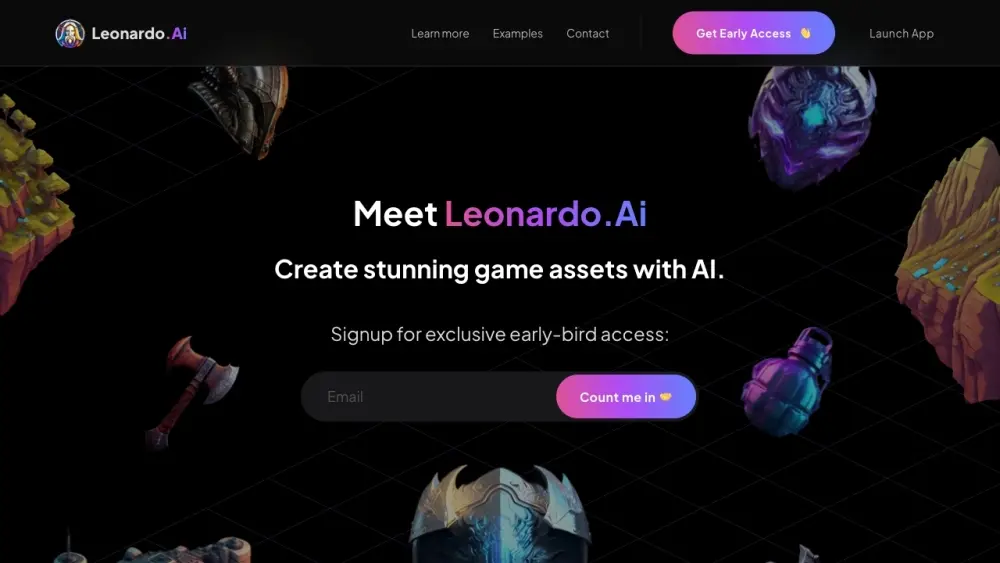
What if you could generate a complete set of high-quality, production-ready game assets in minutes instead of months? Leonardo.ai is an AI-powered image generation platform specifically designed to tackle the immense time and cost challenges of creating visual content for games, digital art, and design projects. It moves beyond simple image creation, offering a suite of professional tools for texture generation, style consistency, and detailed editing.
Key Features
- Text-to-Image Generation: Core feature that transforms detailed text descriptions into high-resolution, stylized images, offering extensive control over model choice and output parameters.
- AI Canvas: An in-browser editing suite allowing for outpainting, inpainting, and detailed manipulation of generated images using both text prompts and brush tools for precise control.
- 3D Texture Generation: Specialized toolset for creating seamless, tileable textures and material maps for 3D models, significantly speeding up asset pipeline workflows for game developers.
- Fine-Tuned Models: Access to a library of community and platform-trained models pre-trained on specific styles like photorealism, anime, or concept art for more accurate and consistent results.
- Real-Time Canvas: Enables live generation where the image updates as you type your prompt, allowing for rapid iteration and immediate visual feedback on creative ideas.
- Prompt Guidance: Advanced settings that provide granular control over how closely the AI adheres to your text prompt, balancing creativity with precision.
- Asset Management: Integrated platform features for organizing generated images into projects, making it easier to manage large-scale creative workflows.
- Image-to-Image: Upload an initial image to use as a visual reference or base, guiding the AI's generation towards a specific composition, style, or color palette.
- Alchemy (V2): A premium generation engine that enhances image quality, detail, and prompt adherence, producing outputs with higher fidelity and more vibrant colors.
- Motion Generation: Expands creative possibilities by animating still images, creating short video clips or GIFs to bring concepts and characters to life.
- Photoreal Generation: Capability to produce images that are indistinguishable from real photographs, useful for architectural visualization and product mockups.
- Community Models: Users can train and publish their own custom models on personal datasets, fostering a shared ecosystem of unique and niche artistic styles.
Pros
- Production-Quality Output: Generates high-resolution, commercially viable assets suitable for professional game development and digital art projects.
- Specialized for Game Art: Offers unique, targeted features like 3D texture generation that are invaluable for developers and 3D artists, setting it apart from generalist tools.
- Powerful Editing Suite: The AI Canvas provides robust inpainting and outpainting tools, giving users significant control to refine and edit generated images without leaving the platform.
- Rapid Iteration Speed: Dramatically accelerates the concept art and asset creation process, allowing for the exploration of dozens of ideas in a short timeframe.
- Strong Style Consistency: Fine-tuned models and prompt guidance features help maintain a coherent visual style across multiple generated assets for a unified project look.
- Active Community: A large user base that shares prompts, custom models, and tips, creating a valuable resource for learning and inspiration.
- Freemium Accessibility: A generous free tier allows users to extensively test the platform's capabilities and complete small projects before committing to a paid plan.
- Continuous Innovation: The development team frequently rolls out major new features like Motion and Alchemy, demonstrating a strong commitment to improving the tool.
Cons
- Steep Learning Curve: Mastering effective prompt engineering and navigating the vast array of settings and models requires significant time investment and experimentation.
- Credit System Complexity: The token-based generation system for free and paid plans can be confusing to track and may limit workflow fluidity during intensive creation sessions.
- Inconsistent Output Quality: Despite advanced models, results can sometimes be unpredictable, requiring multiple generations to achieve a desired outcome, which consumes credits.
- Limited Free Tier for Pros: The daily token refresh, while generous for hobbyists, is often insufficient for the high-volume needs of professional artists or development studios.
- No API Access: Unlike some competitors, Leonardo.ai does not currently offer a public API, limiting its integration into automated pipelines and custom applications.
- Occasional Platform Performance: During periods of high demand, generation queues can form, and the interface may experience lag, interrupting the creative workflow.
- Watermarks on Free Tier: Images generated on the free plan include a Leonardo.ai watermark, which necessitates a paid subscription for commercial use or clean assets.
Use Cases
- Game Asset Creation: Rapidly generating concept art, character designs, environment props, and UI elements for video games, from indie projects to larger studios.
- 3D Model Texturing: Creating seamless, high-resolution diffuse, normal, and roughness maps for 3D objects, drastically reducing the time spent on manual texturing work.
- Concept Art Exploration: Visualizing a wide range of ideas and artistic directions for films, animations, or books quickly during the early stages of pre-production.
- Digital Illustration: Assisting artists in creating base images, backgrounds, or elements that are then refined and integrated into larger, more complex final pieces.
- Architectural Visualization: Generating photorealistic interior and exterior renderings, furniture, and decor items based on textual descriptions for client presentations.
- Marketing and Advertising: Creating unique, royalty-free stock imagery, social media graphics, and product mockups for campaigns without the cost of a photoshoot.
- Character Design: Developing a consistent cast of characters with varied outfits, poses, and expressions, ideal for storyboarding and narrative projects.
- Board Game Design: Producing all visual components for tabletop games, including card art, box covers, and player tokens in a cohesive artistic style.
Pricing & Plans
Leonardo.ai operates on a freemium model. The free plan offers a limited number of tokens per day to generate images. Paid subscription tiers (e.g., Apprentice, Artisan, Maestro) offer increasing monthly token allowances, faster generation speeds, priority queue access, advanced features like Alchemy, and the removal of watermarks. Pricing is typically structured on a monthly or annual basis.
Quick Start Guide
1. Sign up for a free account on the Leonardo.ai website. 2. Explore the 'AI Image Generation' tab, enter a descriptive prompt, and select a pre-trained model. 3. Generate your first image, then use the 'AI Canvas' to edit it further with inpainting or outpainting tools.
Conclusion
Leonardo.ai stands out as a powerful, specialized tool for digital creators, particularly in the game development and 3D art spaces. Its focus on production-quality assets and professional-grade editing tools like the AI Canvas and 3D texture generator provides tangible value that goes beyond simple image creation. While the learning curve and credit system present initial hurdles, the payoff in accelerated workflow and creative potential is significant. It is most highly recommended for game developers, 3D artists, and digital illustrators who need a robust, feature-rich platform for generating and refining professional visual content.
Frequently Asked Questions
Yes, Leonardo.ai offers a freemium model. The free plan provides a daily allowance of tokens that refresh every 24 hours, allowing users to generate a limited number of images. Outputs on the free plan include a watermark.
The free tier limits the number of images you can generate per day via a token system, places you in a standard queue which can be slower during peak times, applies a watermark to all images, and restricts access to some premium features like higher generation speeds and Alchemy.
Yes, but typically only on a paid subscription plan. Images generated on the free tier are for personal use and include a watermark. Paid plans grant you a license to use generated assets for commercial projects.
As of now, Leonardo.ai does not have a public API available for general users. All generation and editing is done through their web-based platform interface.
Alchemy is an advanced, premium generation engine that significantly enhances image quality, detail, color vibrancy, and adherence to the text prompt. It produces more photorealistic and visually striking results compared to the standard models.
Yes, a feature called 'Training & Datasets' allows users to upload their own images to fine-tune and create a custom model tailored to a specific style, character, or object, which can then be used for generation.
Each image generation consumes a certain number of tokens, which varies based on resolution and the engine used (e.g., Alchemy costs more). Your plan provides a monthly or daily token allowance. Unused tokens on paid plans may roll over depending on the specific tier.
Maximum resolution depends on the model and your plan. Standard generations often go up to 1024×1024 or similar, but features like 'High Resolution' upscaling or Alchemy can produce much larger and more detailed images.


