

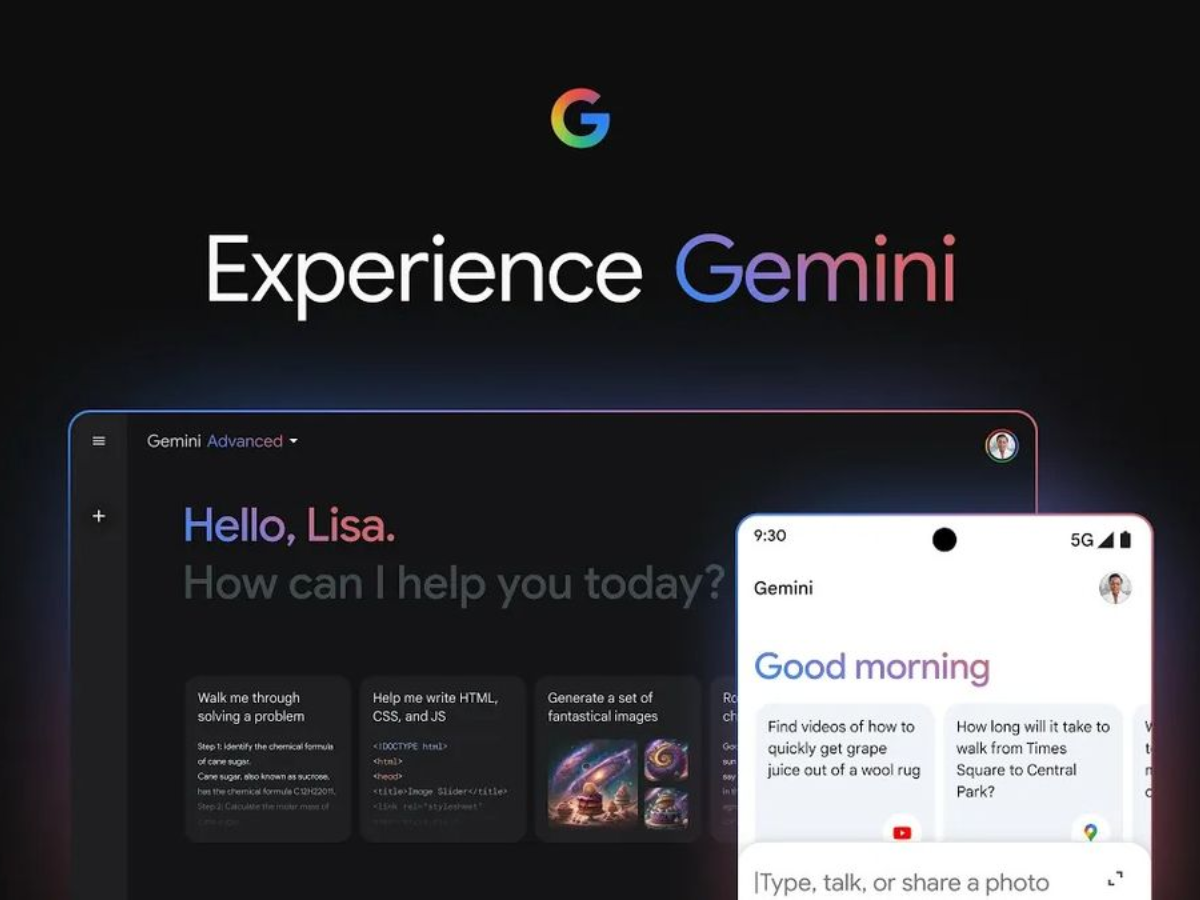
Overview
What if a single AI could seamlessly understand and reason across text, images, audio, video, and code? Google's Gemini 3 Pro represents a significant leap in multimodal intelligence, moving beyond simple text generation to a more integrated, contextual form of problem-solving. It's designed not just to answer questions but to synthesize complex, multi-format information, helping to bring ambitious ideas to life with a depth of understanding previously unavailable in a single model.
Key Features
- Advanced Multimodal Reasoning: Processes and connects information from text, images, audio, and video within a single context window, enabling sophisticated analysis of complex, mixed-media prompts.
- State-of-the-Art Long-Context Understanding: Maintains coherence and recall over extremely long documents or conversations, allowing for deep analysis of large codebases, research papers, or lengthy transcripts.
- Sophisticated Code Generation & Debugging: Writes, explains, refactors, and debugs code across numerous programming languages, understanding context from both code snippets and natural language instructions.
- High-Fidelity Image Analysis: Interprets and describes visual content in detail, from photographs and diagrams to complex infographics, extracting actionable insights and answering nuanced questions about the imagery.
- Audio & Video Comprehension: Analyzes audio tracks and video footage, providing summaries, transcribing speech, identifying key moments, and understanding the context between visual and auditory elements.
- Complex Information Synthesis: Excels at pulling together data from disparate sources and formats to create cohesive summaries, research reports, or strategic plans, connecting dots that other tools might miss.
- Enhanced Safety & Alignment: Built with robust safety classifiers and reinforcement learning from human feedback (RLHF) to reduce biases and minimize the generation of harmful or inaccurate content.
- Creative Ideation & Content Development: Assists in brainstorming and developing creative projects, from writing stories with detailed plot points to generating marketing campaign ideas based on visual mood boards.
- Real-Time Web Connectivity: Can optionally access and process live information from the web to provide answers that incorporate the most current data, news, and research available online.
- Seamless Tool & API Integration: Designed to interact with external tools, APIs, and software, allowing it to perform actions like executing code, retrieving data, or controlling other applications based on user commands.
Pros
- Unified Multimodal Interface: Eliminates the need to switch between different single-purpose AI tools, offering a powerful, all-in-one platform for text, code, image, and audio tasks, drastically improving workflow efficiency.
- Superior Reasoning Capabilities: Demonstrates a significant step-change in its ability to reason through multi-step problems, understand nuanced intent, and provide well-justified, logical answers instead of superficial responses.
- Exceptional Context Length: Handles long-form content with ease, making it ideal for developers analyzing entire code repositories, researchers reviewing lengthy papers, or writers editing book-length manuscripts without losing context.
- High-Quality Code Assistance: Serves as an advanced programming partner that not only generates code but also offers insightful explanations, suggests optimizations, and helps debug complex issues more effectively than many dedicated coding AIs.
- Strong Creative Versatility: Adapts to a wide range of creative and analytical tasks, from technical writing and data science to marketing content creation and academic research, demonstrating remarkable flexibility across domains.
- Robust Knowledge Base & Web Access: Leverages Google's vast knowledge graph and the option for real-time web search, ensuring responses are informed by a comprehensive and up-to-date understanding of the world.
- Continuous Improvement: As a flagship Google AI product, it benefits from rapid, ongoing updates and improvements, meaning its capabilities and performance are consistently expanding and refining over time.
- User-Friendly Accessibility: Accessed primarily through a clean, web-based chat interface (and eventually APIs), lowering the barrier to entry for users who may not have technical expertise to deploy complex AI models.
Cons
- Potential for Occasional Inaccuracies: Like all large language models, it can sometimes generate plausible-sounding but incorrect or misleading information (hallucinations), requiring users to verify critical facts and outputs.
- Computational Resource Intensity: Operating the most advanced version of the model requires significant processing power, which can sometimes lead to slower response times during peak usage or for extremely complex requests.
- Variable Output Quality: The quality and depth of responses can be highly dependent on the specificity and quality of the user's prompt, necessitating some skill in crafting effective instructions to get the best results.
- Inherent Model Biases: Despite safety training, the model may still reflect biases present in its vast training data, which could manifest in its responses and requires conscious oversight from the user.
- Limited Control Over Creativity: While versatile, its creative outputs (like story generation or art direction) might sometimes lack a truly unique or deeply original spark, occasionally feeling derivative of its training material.
- Privacy Considerations for Sensitive Data: Users must be cautious about inputting highly sensitive, proprietary, or personal information into a cloud-based model, as data handling policies should be thoroughly reviewed.
- Evolving and Sometimes Unclear Pricing: Access tiers and pricing structures for the most powerful versions of the model may change, potentially creating cost uncertainty for heavy users or businesses looking to scale.
Use Cases
- Technical Research & Development: Accelerates R&D by analyzing complex research papers, synthesizing findings from text and diagrams, and generating hypotheses or code prototypes for scientific computing and engineering projects.
- Comprehensive Content Creation & Strategy: Serves as a central content hub for marketing teams, generating blog outlines from keyword research, writing video scripts based on storyboards, and devising multi-platform campaign strategies.
- Advanced Software Engineering: Functions as a senior programming assistant, reviewing pull requests, refactoring legacy codebases for efficiency, writing comprehensive unit tests, and debugging intricate, multi-system errors.
- Multimedia Analysis & Summarization: Processes hours of podcast audio or video meeting recordings to create detailed transcripts, extract key action items, and generate executive summaries with timestamps for important moments.
- Personalized Education & Tutoring: Acts as an adaptive tutor, explaining complex mathematical concepts with drawn diagrams, helping language learners through conversation practice, and breaking down historical events from multiple sources.
- Data Science & Business Intelligence: Interprets complex charts and datasets, suggests appropriate statistical analyses, generates Python code for data manipulation, and writes reports that explain insights to non-technical stakeholders.
- Creative Storytelling & Worldbuilding: Assists authors and game designers by generating character backstories, plotting narrative arcs, describing fictional settings from inspiration images, and maintaining consistency in large worlds.
- Accessibility Support: Enhances accessibility by providing rich descriptions of images for the visually impaired, generating captions for videos, and simplifying complex text into easy-to-understand language for diverse audiences.
- Strategic Business Analysis: Analyzes quarterly reports, market news, and competitor data to identify industry trends, assess potential risks, and generate SWOT analyses to support executive decision-making and strategic planning.
Pricing & Plans
Gemini typically follows a freemium model. A free tier is available through its web interface with standard capabilities and rate limits. A paid 'Gemini Advanced' subscription (often bundled with a Google One plan) provides access to the most powerful Ultra models, significantly higher rate limits, and enhanced features. API access for developers is priced based on usage (per character or per image), with separate tiers for different model capabilities.
Quick Start Guide
1. Navigate to the Gemini website or app and sign in with your Google account. 2. Start a new chat and type your question or instruction. For best results, be specific and provide context. 3. To use its multimodal features, click the image upload button to include photos, screenshots, or documents for analysis. 4. Refine your responses by asking follow-up questions or using prompt techniques like 'reason step-by-step' for complex tasks.
Conclusion
Gemini 3 Pro is not an incremental update but a substantive evolution toward a more general, capable, and integrated form of artificial intelligence. Its core strength lies in its native multimodality—its ability to reason across different types of information as humans do, making it exceptionally powerful for complex, real-world tasks that are never purely textual. It is highly recommended for developers, researchers, content strategists, and any knowledge worker who deals with multifaceted information. However, users should approach it as a powerful co-pilot rather than an infallible oracle, always maintaining a critical eye toward its outputs, especially for fact-critical applications. Its value increases dramatically for those willing to learn prompt engineering and integrate it deeply into complex workflows.
Frequently Asked Questions
Yes, a free tier is available through the Gemini chat interface, offering access to a capable model. The most advanced 'Pro' or 'Ultra' models typically require a paid Gemini Advanced subscription.
The free tier may use a less powerful model, have lower daily usage limits, and lack access to some advanced features like extended context windows or integration with Google Workspace apps that are included in paid plans.
Yes, it can process text from uploaded PDFs, Word documents, and images of text. It can summarize, answer questions about the content, and extract key information, making it useful for research and document review.
Google states that user conversations are used to improve the model but that human reviewers do not see data labeled as private. For the paid tier, Google asserts that user data is not used for model training. Always review the current privacy policy for details.
Yes, Google offers an API for developers to integrate Gemini's capabilities into their own applications, websites, and services. Pricing is typically based on the number of input and output characters processed.
The model's internal knowledge has a cutoff date. However, a key feature is its optional ability to perform live web searches to augment its responses with the most current information available online.
While specifics evolve, the most advanced versions support a very long context window (often cited in the millions of tokens), allowing it to maintain context over long conversations, large documents, and complex codebases.
It is considered a direct competitor, often rivaling or exceeding GPT-4 in certain benchmarks, particularly in multimodal reasoning and coding tasks. Its deep integration with Google's ecosystem is also a key differentiator.
You can commonly upload images (JPG, PNG), PDFs, and text files. Some interfaces may support video and audio files for analysis, allowing the model to describe content or transcribe speech.