
Overview
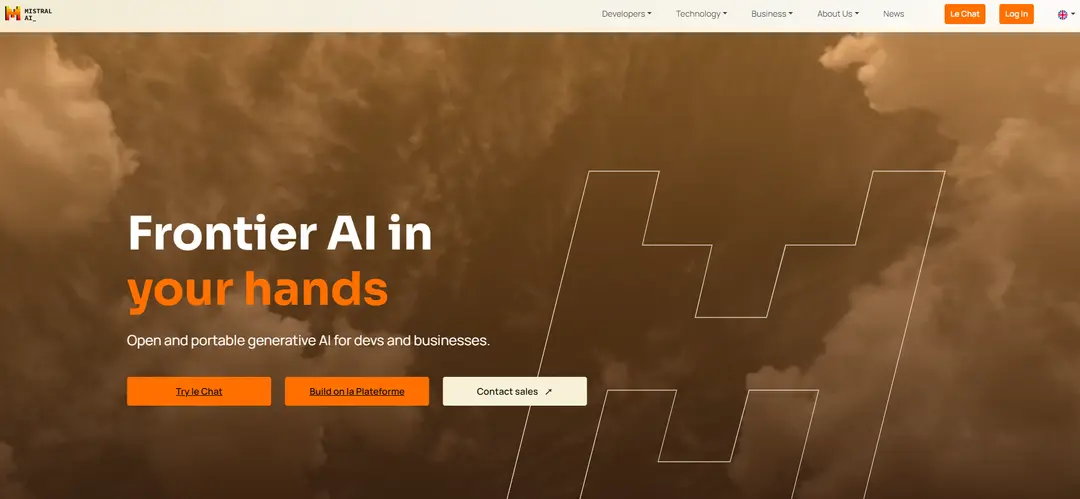
How does a European startup challenge Silicon Valley's AI dominance with open models? Founded in 2023 by former Google DeepMind and Meta researchers, Mistral AI rapidly achieved billion-dollar valuation by delivering state-of-the-art language models that balance open-source accessibility with commercial-grade performance. Their approach emphasizes efficiency, multilingual capability, and customizability without vendor lock-in.
Key Features
- Open-weight models: Mistral releases models like Mistral 7B under Apache 2.0 license, allowing complete freedom for modification, distribution, and commercial use without restrictions.
- Efficient architecture: Optimized for high performance with lower computational requirements, delivering competitive results at reduced latency and operational costs.
- Multilingual proficiency: Native support for English, French, German, Spanish, Italian, and coding languages without requiring additional prompt engineering.
- Customization framework: Provides comprehensive fine-tuning capabilities allowing businesses to adapt models to specific domains and use cases.
- Flexible deployment: Available through serverless APIs, major cloud platforms (Azure AI, Amazon Bedrock), and for on-premise installation with full data control.
- Code specialization: Strong performance in code generation, completion, and explanation across multiple programming languages and frameworks.
- Transparent development: Open-weight approach allows researchers and developers to inspect, audit, and understand model architecture and training methodologies.
- Enterprise security: Offers private deployment options with data encryption and compliance features for regulated industries.
- Scalable infrastructure: Designed to handle high-volume requests with consistent performance across varying load conditions.
- Continuous innovation: Regular releases of new models and capabilities, including recent FLUX1.1 [pro] for advanced reasoning tasks.
- Developer tools: Comprehensive SDKs, documentation, and support for integration into existing workflows and applications.
- Community engagement: Active research collaboration and open discussion around model improvements and ethical AI development.
Pros
- Cost efficiency: Lower operational costs compared to similar-sized models from competitors due to optimized architecture and pricing.
- Transparency: Open-weight models provide visibility into model architecture and training approaches rather than black-box solutions.
- Deployment flexibility: Multiple deployment options including cloud APIs, private cloud, and on-premise installations for different security needs.
- Multilingual capability: Strong native performance across European languages without requiring additional translation layers.
- Customization potential: Extensive fine-tuning capabilities allow organizations to create specialized models for unique requirements.
- Developer friendly: Well-documented APIs, SDKs, and community support facilitate integration and development.
- Innovation pace: Rapid iteration and model improvements demonstrated through frequent releases and capability enhancements.
- Data sovereignty: European-based company provides alternative for organizations concerned about data governance and regulations.
- No vendor lock-in: Open-weight models can be migrated between platforms and providers without compatibility issues.
Cons
- Limited track record: As a newer company, lacks the extensive deployment history and reliability data of established competitors.
- Ecosystem maturity: Smaller third-party tool and integration ecosystem compared to longer-established AI platforms.
- Technical complexity: Customization and optimization may require more expertise than turnkey solutions from larger providers.
- Documentation gaps: Some advanced features may have less comprehensive documentation compared to mature platforms.
- Support scalability: Enterprise support capabilities may still be developing compared to established enterprise AI providers.
- Model variety: Fewer specialized model variants available compared to platforms with longer development histories.
- Benchmark data: Limited independent third-party benchmarking across diverse use cases and industry applications.
Use Cases
- Content creation: Generating marketing copy, technical documentation, and creative content across multiple languages and industries.
- Code assistance: Automated code completion, bug fixing, and documentation generation for software development teams.
- Customer support: Powering multilingual chatbots and virtual assistants for 24/7 customer service and query resolution.
- Data analysis: Interpreting complex datasets, generating reports, and extracting actionable insights from unstructured information.
- Educational tools: Creating personalized learning materials, tutoring systems, and knowledge assessment platforms.
- Research assistance: Literature review, hypothesis generation, and scientific writing support across technical domains.
- Legal documentation: Drafting and reviewing legal documents, contracts, and compliance materials with precision.
- Technical translation: Converting technical documentation and specifications between supported languages accurately.
- Business intelligence: Analyzing market trends, generating reports, and summarizing business information from multiple sources.
Pricing & Plans
Mistral AI operates on a freemium model. Open-weight models (Mistral 7B, Mixtral 8x7B) are free to download and use. Commercial API access follows pay-per-use pricing based on token consumption, with Mistral Large priced at $8/1M input tokens and $24/1M output tokens. Enterprise plans include volume discounts, dedicated support, and private deployment options. Free tier available through Le Chat interface with daily limits.
Quick Start Guide
1. Visit chat.mistral.ai to experiment with Le Chat's free interface using various models. 2. Register at console.mistral.ai to access La Plateforme developer console. 3. Generate your API key in the dashboard for programmatic access. 4. Integrate using provided SDKs or direct API calls to begin developing applications.
Conclusion
Mistral AI represents a significant alternative in the LLM landscape, particularly for organizations valuing transparency, cost efficiency, and multilingual capability. Their open-weight approach provides unusual flexibility for customization and deployment, though requires more technical expertise than turnkey solutions. Recommended for developers and enterprises seeking customizable AI solutions with strong European language support, especially those concerned about vendor lock-in or requiring private deployment. The platform is particularly suited for technical applications, multilingual projects, and organizations with specific compliance requirements. For simple chatbot implementations or users needing extensive third-party integrations, more established platforms might offer better immediate solutions.
Frequently Asked Questions
Open-weight models are free to download, modify, and use commercially under Apache 2.0 license. Commercial models are accessed via API with additional capabilities and support, but without weight access.
Yes, through Le Chat interface at chat.mistral.ai with daily usage limits. Open-weight models are completely free to download and self-host.
Mistral models support major languages including Python, JavaScript, Java, C++, Go, Rust, and more with strong performance for completion and explanation.
Yes, Mistral provides comprehensive fine-tuning capabilities allowing customization for specific industries, terminologies, and use cases.
Rate limits vary by plan, with free tier having lower limits. Enterprise plans offer higher throughput and customizable rate limiting.
All API communications use TLS encryption. Enterprise plans offer additional encryption options for data at rest.
Mistral typically offers competitive pricing, often lower than equivalent-tier models from major providers, especially for European language processing.
Community support for open models, email support for API users, and dedicated technical support for enterprise customers.
Yes, enterprise plans include options for full on-premise deployment with complete data isolation.
Mistral has maintained a rapid release cadence, with major model updates every few months and incremental improvements more frequently.